Jaxx liberty customer service provides technical guidance for wallet setup, cross-platform synchronization, and secure asset recovery through seed phrase management. As a non-custodial platform, we empower you with absolute control over your private keys while offering structured support for multi-chain integrations, software updates, and transaction troubleshooting to ensure your digital portfolio remains accessible and secure across all devices.
Common Support Requests and the Best Information to Prepare
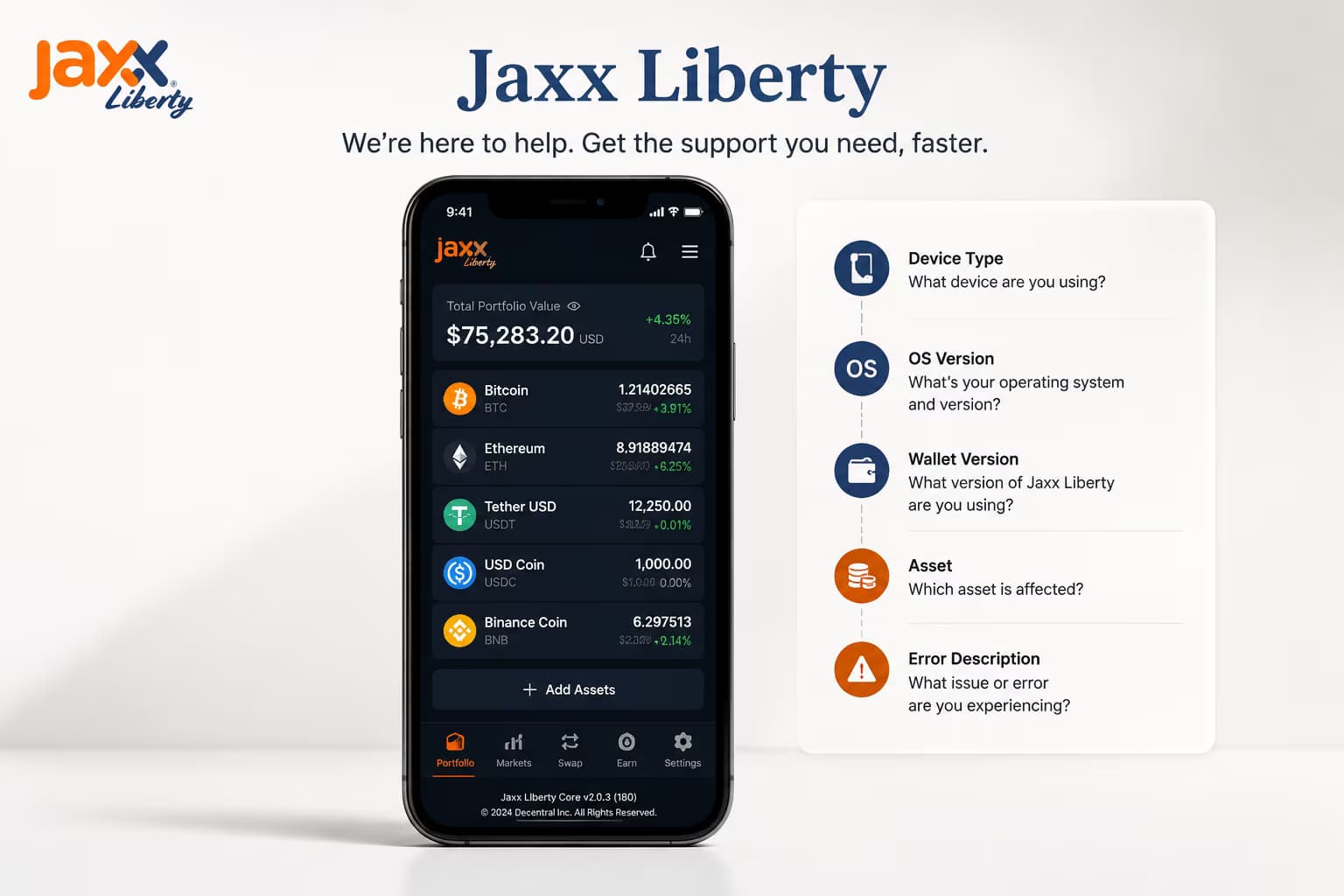
To ensure we can provide the most accurate technical guidance for your Jaxx Liberty Wallet, please prepare the specific diagnostic details associated with your issue. Having this information ready allows for a faster resolution while maintaining the security of your non-custodial environment.
| Issue Type | Required Diagnostic Details | Actionable Preparation |
|---|---|---|
| Seed Phrase Errors (Typos/Order) | 12-word phrase status | Verify the exact spelling and sequence of your recovery words against the BIP39 standard. |
| Missing Coins or Sync Issues | TXID, Asset Type | Provide the Transaction ID (TXID) and the specific asset (e.g., BTC, ETH) involved. |
| Wallet File Corruption | OS & Wallet Version | Identify your device type (Mobile/Desktop), OS version, and the Jaxx Liberty version installed. |
| Migration or Import Errors | Target Wallet Name | Note the name of the new wallet application you are using to import your Jaxx Liberty seed. |
| Forgotten Password/Access | Local File Status | Confirm if you have physical access to the device where the wallet was originally initialized. |
Why Non-Custodial Wallet Support Has Strict Limits
Jaxx Liberty support hits a hard wall the moment you expect it to override your private keys — and that wall is the entire point of how the wallet works. Your keys are generated locally, stored on your device, and never touch our servers. Not once. Which means no support agent, no matter how senior, can reset your credentials, restore your access, or move your funds. That’s not a service gap. That’s self-custody doing exactly what it promises.
As Stripe breaks it down in their non-custodial wallet overview, exclusive user control over private keys is the structural backbone of this entire wallet model — third-party access isn’t restricted by policy, it’s architecturally impossible. Jaxx Liberty runs on the same zero-knowledge principle. No seed phrase database. No email-linked account records. No backend recovery lever to pull. When users come to us for wallet recovery guidance, support walks you through the restoration process using your seed phrase — but that phrase has to come from you. No escalation path changes this. None.
Here’s the one truth that makes everything else make sense: your 12-word seed phrase is the only credential that controls your wallet. Full stop. Have it? You can restore access on any supported device, anytime. Don’t have it? Access is gone — for you and for us equally. This isn’t careless design. It’s a deliberate trade: your complete sovereignty over your funds in exchange for carrying the full weight of that responsibility. In a landscape where phishing attacks grow sharper every year, keeping your keys off centralized servers is one of the most concrete protections a crypto user can have.
So what can support actually do? Plenty. Troubleshooting sync problems, walking you through wallet restoration with an existing seed phrase, clarifying supported assets, answering technical questions across desktop and mobile — that’s real, substantive help. To get the most out of it, come prepared: know your device type, operating system, wallet version, and have a clear description of what went wrong. The more precise your details, the faster and more targeted the guidance. Jaxx Liberty support exists to help you use the wallet well — and being honest about where our technical reach ends is part of that job, not an excuse to avoid it.
What to Do Before You Contact Jaxx Liberty Support
To ensure our technical team can provide the most efficient assistance, please follow this checklist to gather necessary diagnostics before reaching out. Remember that Jaxx Liberty is a non-custodial wallet; we do not have access to your funds, private keys, or seed phrases.
- Verify your backup. Confirm that you have your 12-word backup phrase written down and stored securely. Since we do not use accounts or emails, this phrase is the only way to restore access to your assets if a technical issue occurs during troubleshooting.
- Document your environment. Note the exact version of Jaxx Liberty you are running and the operating system of your device (e.g., Android 14, iOS 17, or Windows 11). Compatibility issues are often specific to certain software environments.
- Identify the specific asset. If you are experiencing a transaction or balance issue, identify the specific cryptocurrency involved (e.g., Bitcoin, Ethereum, or Litecoin). Check a public block explorer to see if the transaction is confirmed on the blockchain.
- Capture the error details. Take a screenshot or write down the exact text of any error messages you receive. This helps us pinpoint whether the issue is local to your device or related to network synchronization.
- Check your connection. Ensure you have a stable internet connection and are not using a VPN or firewall that might block the wallet’s ability to communicate with blockchain nodes.
- Protect your sensitive data. Never share your 12-word backup phrase or private keys with anyone, including Jaxx Liberty support. We will never ask for this information, and providing it puts your funds at immediate risk of theft.
Setup, Access, and Recovery Questions Users Ask Most Often
Three problems eat up the vast majority of Jaxx Liberty support requests: getting the wallet configured right from day one, recovering access after a device swap or fresh install, and actually understanding the restore process before you desperately need it. Jaxx Liberty runs on a non-custodial model — no account, no email, no password reset button, no company holding your hand. Your entire access lives inside a 12-word backup phrase, generated locally on your device the second you create a wallet. Write it on paper. Lock that paper somewhere safe. Never type it into anything except the official restore screen. That one habit is the difference between recovering your funds effortlessly and losing everything permanently.
Restoring access after a reinstall, a new phone, or a crashed app? The mechanics are simple. Brutal, but simple. You enter your backup phrase — every word, in exact order — through the wallet import flow. Jaxx Liberty keeps nothing on any server. Zero. Which means if you lost your phrase, no support ticket on earth brings it back. Not through escalation, not through any tool, not through anyone. This is architecture, not negligence — local key storage is precisely what puts you in full control of your assets. Before you wipe a device or clear app data, verify your phrase is written down and within reach. As Coin Bureau points out, the platform places full operational responsibility on the user — that’s the entire point of self-custody, not a footnote buried in the FAQ.
When restore attempts go wrong, the culprit is almost always the same handful of mistakes. Wrong word order. A misspelling. Mixing up two words that sound alike from the BIP39 list. The restore flow ignores capitalization, but word sequence is absolute — one transposition generates a completely different wallet, empty, belonging to no one you know. If you restore and see zero funds, stop. Do not send anything to that address. Go back to your written backup, verify each word, confirm the order, and try again with fresh eyes. Worth knowing: if you set up Jaxx Liberty on both desktop and mobile, the same phrase unlocks both — cross-platform access works because the key derivation logic underneath is identical regardless of device.
A few sharp habits that keep users out of the support queue entirely. Always update to the latest version of Jaxx Liberty before running a restore — older builds can behave unpredictably with specific asset types or derivation paths, and that unpredictability is avoidable. After restoring a wallet with multiple cryptocurrencies — Bitcoin, Ethereum, Litecoin, and others in the supported lineup — check your portfolio settings manually. Some tokens require explicit activation and won’t appear automatically. And when you do reach out for support, come prepared: device type, operating system version, wallet version, the specific asset involved, and a clear description of exactly where the process broke down. Vague reports get generic answers. Precise details get real solutions.
If you need assistance with setting up your Jaxx Liberty mobile wallet or managing your multi-asset portfolio, our guided connection process provides the necessary technical steps to ensure your self-custody environment is configured correctly.
Support Limits vs Support Actions
Understanding the non-custodial nature of Jaxx Liberty is essential for managing your digital assets securely. Because we do not store your private keys or personal data on our servers, our support team provides technical guidance and troubleshooting without ever having access to your funds or recovery phrase.
| Category | Jaxx Liberty Support Can | Only You (The User) Can |
|---|---|---|
| Wallet Access | Troubleshoot app installation and updates | Manage your 12-word seed phrase and PIN |
| Security & Recovery | Provide recovery instructions and best practices | Perform a wallet restore using your backup phrase |
| Transactions | Diagnose transaction status on the blockchain | Authorize, sign, and broadcast any fund transfers |
| Data Privacy | Assist with general technical questions | Maintain exclusive control over private keys |
| Account Management | Explain multi-asset setup and interface features | Reset or change local security settings |
Support, Regulation, and What Agents Are Allowed to Say
Jaxx Liberty support does one thing well: it solves technical problems — and it stops exactly where financial advice begins. That boundary is not an accident. When you reach out through Jaxx Liberty support contact channels, the agents on the other end are trained for software, not markets. Wallet setup. Asset display glitches. Sync failures. Transaction status questions. Platform-specific quirks. That is their territory. Telling you which assets to hold, predicting what your transaction will do, or touching anything inside your wallet on your behalf? Not their job. Not ever.
There is a regulatory reason this line exists. As SIFMA laid out in its 2026 input to the SEC Crypto Task Force, function-based regulation draws a hard distinction between technical software tools and licensed financial activities like broker-dealer functions. Jaxx Liberty sits firmly in the software category — not the financial intermediary category. So Jaxx Liberty transaction support covers how a transaction gets constructed, broadcast, and displayed inside the interface. Full stop. Whether that transaction is financially smart, timed correctly, or aligned with market conditions? That falls outside the scope entirely. Crossing into that territory would push a software provider into regulated ground it has no license to occupy.
This structure protects you. Because Jaxx Liberty never holds your private keys — they live locally on your device, locked to your seed phrase — there is no technical pathway for anyone on the support side to act inside your wallet even if they tried. Jaxx Liberty user support agents cannot access your funds, reverse a confirmed transaction, or recover anything without your seed phrase. What they can do is walk you through troubleshooting steps with precision, explain exactly what a specific error message means, and confirm whether a behavior you are seeing is expected in the current software version. That is the complete scope of technical support in a non-custodial environment. No more, no less.
When you contact Jaxx Liberty support, the quality of help you get scales directly with the information you bring. Before submitting a request, have your device type, operating system, wallet version, the specific asset involved, and a clear description of the problem ready. If a transaction is part of the issue, note the transaction ID and the network it was sent on. Support agents use that information to pinpoint whether the root cause is software-side, network-side, or user-side — then guide you from there. They will not make decisions for you. That is precisely how self-custody should work.
Troubleshooting Sync Issues, App Errors, and Update Problems
Most Jaxx Liberty sync failures, app errors, and broken updates have a fix — and it almost always comes down to finding the actual root cause, not just restarting and hoping. Before you do anything else, ask yourself one question: is this problem happening on your device, or is the network just slow? Blockchain nodes get congested. They lag. Your balance display can sit frozen while the actual on-chain state has already moved — and that’s not your wallet breaking, that’s distributed infrastructure doing what distributed infrastructure does. A full app restart with time to complete a sync cycle clears this in most cases.
Cache corruption is the next thing to suspect when problems stick around. Local data builds up over time, drifts out of alignment with the current blockchain state, and suddenly you’re staring at wrong balances, missing assets, or a startup screen that just spins. On Android, go into your device’s application settings and clear the app cache directly. On iOS and desktop, a clean reinstall forces Jaxx Liberty to rebuild everything from scratch. One thing before you do that — make absolutely sure your 12-word backup phrase is written down and stored somewhere safe. Reinstalling wipes the local app data. Your funds don’t disappear. Your private keys don’t disappear. Everything recovers through the seed phrase, every single time.
Interrupted updates deserve their own category of frustration. An install that gets cut off halfway leaves the app in a genuinely broken state — bad node connections, UI elements that won’t render, errors that look catastrophic but aren’t. The fix is straightforward: uninstall the current version completely, pull the latest release from the official source, and do a clean install. As Coin Bureau points out, how well the wallet performs is tightly bound to local device conditions — your OS version, available storage, network stability. Running the app on an outdated operating system or a device that’s nearly full can produce crashes and sync failures that look like wallet problems but are really just resource problems.
Work through this systematically and you’ll find the answer faster. Start with your internet connection. Then narrow it down — does the issue hit one asset or everything? Node delays tend to be asset-specific. Cache corruption usually takes down the whole app at once. If you’ve restarted, cleared the cache, and confirmed your connection and the problem is still there, document everything before contacting support: device model, OS version, app version, the specific asset involved, and exactly what the error looks like. That information cuts the back-and-forth in half and gets you to a resolution without the usual «can you tell us more about your setup» delay.
Security Principle Every Support Request Should Follow
No real Jaxx Liberty security support will ever ask for your backup phrase, private key, or any credential that unlocks your wallet — full stop. This goes beyond policy. It is baked into the architecture itself. Jaxx Liberty runs as a non-custodial wallet, which means your private keys live on your device and nowhere else. No server holds them. No support agent can reach them. Nobody on the Jaxx Liberty side can access your funds, override your access, or pull your seed phrase from some database — because that database does not exist. Any message, email, or chat offering backup phrase «help» in exchange for your recovery phrase is a scam. Every single time.
When you contact Jaxx Liberty for user help, the details that actually move the needle are straightforward: your device type, operating system version, app version, the specific asset giving you trouble, and a plain description of what went wrong. That’s it. No credentials. No phrases. A focused support interaction built around those specifics can walk you through sync problems, delayed transactions, display glitches, or setup questions — all without anyone laying eyes on your private keys. The moment a support channel asks for anything beyond that short list, treat it as a red flag. Because it is.
As Stripe explains, the core principle of a non-custodial wallet is that only the user holds the credentials controlling their funds — and legitimate support never needs those credentials handed over. That architecture is a deliberate choice. It gives you full ownership and real control. But it also makes your backup phrase the single thread your wallet recovery hangs on. Protect it accordingly. Write it down on paper, store it somewhere physically secure, and never — under any circumstances — type it into a website, form, or chat window you did not launch directly through the official Jaxx Liberty app.
The rule is blunt: your 12-word backup phrase restores your wallet, and only you should ever hold it. Jaxx Liberty support guidance works around that phrase, not through it. If you are unsure whether a support channel is legitimate, go straight to the official Jaxx Liberty website or app and find verified contact options there. Scammers routinely impersonate wallet support across social media, forums, and email threads. Knowing this one boundary — that real help never asks for your seed phrase — is the most valuable security habit any self-custody wallet user can build. Burn it into your memory before anything else.
Why Fee Questions Reach Support So Often
Fee confusion tops the list of issues users bring to Jaxx Liberty support — and almost every case traces back to the same blind spot: not knowing the difference between a blockchain network fee and an in-app swap spread. When you send Bitcoin, Ethereum, or any other asset from Jaxx Liberty Wallet, that fee goes straight to the blockchain network. Miners and validators collect it. They process your transaction, they confirm it, they get paid. Jaxx Liberty never touches that money — we don’t set it, we don’t receive it, we don’t control it. What we do know is that it swings wildly based on network congestion, block size limits, and real-time demand across the chain. The same send can cost you pocket change on a slow Tuesday and a small fortune during a peak rush hour.
Then there’s the second layer — in-app swaps. When you exchange one asset for another directly inside the wallet, the rate you see already has a spread baked in. A margin built into the exchange rate itself, not tacked on as a separate line item. This is how swap functionality works in a non-custodial environment where no centralized account system exists to absorb those costs. Many users who reach out for asset support assume something went wrong, that they got hit with a hidden fee — when in reality, the spread was already reflected in the quoted rate before they ever hit confirm. As Bitget points out, network fees and wallet-side spreads are fundamentally different beasts, and users who understand both make dramatically smarter decisions about when and how they transact. Know the difference before you swap. Not after.
If you’re contacting support about a fee discrepancy, come prepared. Vague reports don’t move fast. «The fee seemed high» tells us almost nothing. «I sent ETH at 2:00 PM, the fee was X, I’m running wallet version Y on Android» — that’s something we can actually work with. Bring the asset name, the approximate transaction time, your wallet version, and whether the issue involves a send, receive, or swap. Support can then cross-reference network conditions at that exact moment, confirm whether the fee reflected standard blockchain pricing, and give you a real answer instead of a generic one. Precision gets results. Vagueness gets delays.
One thing worth being clear about: Jaxx Liberty stores your private keys locally on your device. That’s the whole point of a non-custodial wallet — your keys, your control. But it also means no one can reverse a confirmed transaction, refund a network fee, or reach into the blockchain and pull anything back. That’s not a support limitation. That’s how blockchain works, by design. What support absolutely can do is walk you through exactly what happened, confirm whether your fee was within normal range for that network at that time, and help you get smarter about managing costs going forward — timing transactions during lower-congestion windows, adjusting fee preferences where the network allows it, and building habits that keep you in control of every send.
Conclusion
Sharp, specific, and prepared — that’s the only way to get real results from Jaxx Liberty support. Before you fire off a message through any available support channel, spend two minutes pulling together what actually matters: your device type and operating system, the exact version of Jaxx Liberty you’re running, the specific cryptocurrency involved, and a crisp account of what broke and when. That groundwork alone cuts the back-and-forth in half and puts your case on the shortest path to a fix.
When you write your request, be surgical. Describe exactly what you saw — not what you felt, not what you guessed — what you literally observed on screen. Include every error message word for word, and list the troubleshooting steps you already tried. A tight, technical message through the Jaxx Liberty support email channel tells the team immediately that you know your setup. Compare that to «my wallet isn’t working.» Useless. Specific details move things forward. Vague complaints just sit in a queue.
Security discipline is non-negotiable here. Your 12-word seed phrase goes to nobody. Not a support agent. Not a forum helper. Not anyone claiming an official role. Your private keys live locally on your device, and no legitimate support process will ever ask you to expose them. Someone requesting your seed phrase isn’t support — it’s a phishing attempt, full stop. Guard that phrase like it’s the only key to a vault that can never be re-keyed, because that’s exactly what it is.
Jaxx Liberty puts you in control: you own the keys, you control the assets. Support exists to help you work through real technical challenges — wallet setup, access questions, asset management, platform-specific issues — but wallet security is your responsibility, not theirs. Use the available resources wisely, stay sharp, and bring both clarity and caution to every interaction. That combination wins every time.
Frequently Asked Questions
Can Jaxx Liberty support reset my wallet or recover my seed phrase?
No. Jaxx Liberty is a non-custodial wallet, meaning your private keys are stored locally on your device and never on any server. Support agents have no technical ability to reset credentials or recover a lost seed phrase — only you can restore access using your 12-word backup phrase.
What information should I prepare before contacting Jaxx Liberty support?
Gather your device type, operating system version, the exact version of Jaxx Liberty installed, the specific cryptocurrency involved, and a clear description of the issue including any error messages. If a transaction is involved, include the Transaction ID (TXID) and the network it was sent on.
Why is my Jaxx Liberty balance not updating or showing missing coins?
Balance display issues are most commonly caused by local cache corruption or temporary blockchain node delays. Try a full app restart, and if the problem persists, clear the app cache on Android or perform a clean reinstall on iOS or desktop — ensuring your 12-word backup phrase is secured before reinstalling.
Will Jaxx Liberty support ever ask for my seed phrase or private key?
Never. Legitimate Jaxx Liberty support will never request your 12-word backup phrase or private keys under any circumstances. Any message or chat asking for this information is a phishing attempt — your seed phrase should only ever be entered directly into the official Jaxx Liberty restore screen.
Why was my transaction fee higher than expected when using Jaxx Liberty?
Transaction fees are set by the blockchain network itself and paid directly to miners or validators — Jaxx Liberty does not receive or control them. Fees fluctuate based on real-time network congestion. For in-app swaps, a spread is built into the exchange rate rather than charged as a separate line item.
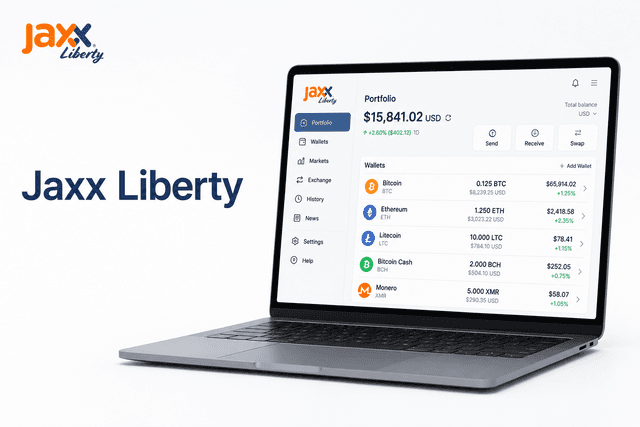 Jaxx Wallet Extension: Fast Browser Crypto Management