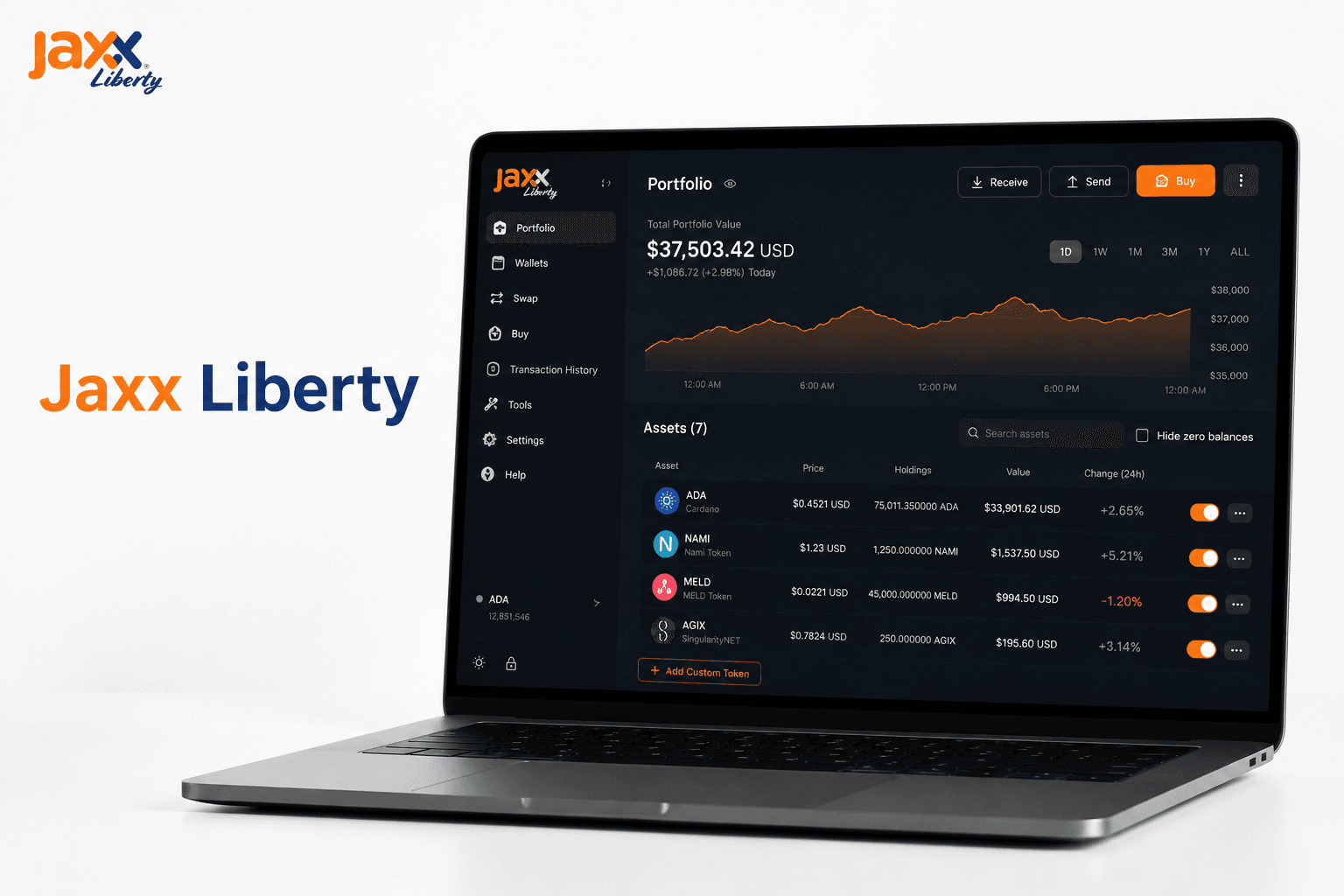
The Cardano Jaxx Wallet integration allows you to manage ADA and native tokens within a unified, non-custodial multi-asset dashboard. By leveraging lightweight node architecture, we provide real-time visibility into your holdings without requiring full blockchain downloads. You can easily toggle asset visibility and monitor your portfolio’s total value while maintaining absolute control over your local private keys.
How multi-chain wallets display ADA balances and activity
Jaxx Liberty tracks your Cardano balance by firing API calls to external Cardano nodes and block explorers — no bloated full node eating your storage, no compromise on accuracy. Open the wallet, trigger a sync, and the app immediately queries the Cardano network for your UTXO set — the underlying data structure that tells the ledger exactly how much ADA you control. Lightweight by design. Fast across every platform. Still precise.
Getting that balance to your screen actually pulls three separate data layers simultaneously: your current ADA balance calculated from unspent transaction outputs, your full Cardano transaction history from indexed APIs, and on-chain metadata for any native tokens sitting in your wallet. The portfolio refreshes on app launch, on manual sync, and through background polling that typically runs every 30 to 60 seconds. As Bitget Web3 confirms, lightweight Cardano wallets connect to external nodes for data access — API-based fetching is simply the standard architecture for non-custodial multi-chain wallets.
Spot a new transaction that hasn’t appeared yet? That 5-to-30-second delay is completely normal. Cardano’s Ouroboros consensus mechanism takes time to propagate confirmed blocks across the network, and external API providers add their own rate limits on top of that. Nothing wrong with your wallet. Nothing wrong with your funds. Once the network locks in the confirmation and the API endpoint catches up, your balance and history sync on their own — no poking required.
Here’s what actually matters for day-to-day portfolio management. Your private keys never leave your device — Jaxx Liberty holds them locally and never ships them to any external server. Every balance figure and transaction record the wallet displays? Read-only data pulled from public Cardano infrastructure. Self-custody stays fully intact even while the app leans on external APIs for what you see on screen. If the numbers look off for a moment, hit manual refresh. That forces a fresh API call against the live Cardano ledger state and clears up the discrepancy almost instantly.
What users can usually manage for Cardano inside Jaxx Liberty
Managing Cardano (ADA) within Jaxx Liberty gives you full control over your assets through a non-custodial interface. You can customize your dashboard, track market movements, and execute transactions while maintaining exclusive ownership of your private keys. The table below outlines the primary management tasks available to you for Cardano operations.
| Management Task | Functionality | User Action & Control |
|---|---|---|
| Wallet Visibility | Interface Customization | Use the «Manage Assets» menu to show or hide Cardano on your main dashboard. |
| Receiving ADA | HD Address Generation | Generate new Hierarchical Deterministic (HD) addresses for each transaction to enhance privacy. |
| Sending ADA | Transaction Broadcasting | Enter recipient address and amount in crypto or fiat; adjust transaction fees as needed. |
| Portfolio Tracking | Real-time Monitoring | View total ADA balance alongside live market data and historical price charts. |
| Security & Backup | Self-Custody Tools | Access your 12-word seed phrase and export private keys for full manual recovery. |
How to find and enable the Cardano wallet view
Managing your Cardano (ADA) assets within Jaxx Liberty is straightforward once you understand how to navigate the multi-chain interface. Since we prioritize user control and local storage of private keys, you must manually ensure the asset is active in your interface to view balances and manage transactions. If you encounter technical difficulties during this process, you can always reach out for Jaxx Liberty wallet support to verify your configuration.
- Open the Menu by tapping the three-line icon (hamburger menu) located in the top right corner of your Jaxx Liberty dashboard to access the customization settings.
- Select «Manage Assets» from the list of options to view the full directory of supported cryptocurrencies available within the wallet.
- Search for Cardano (ADA) by using the search bar at the top of the asset list or scrolling down to find Cardano among the supported blockchains.
- Toggle the Switch next to Cardano to the «On» position, which enables the wallet view and adds the ADA card to your main portfolio interface.
- Return to the Dashboard and verify that the Cardano module is now visible, showing your current balance and providing options to send or receive ADA.
- Confirm Synchronization by ensuring your device has a stable internet connection, allowing the wallet to communicate with the Cardano blockchain and update your transaction history.
- Secure Your Backup by double-checking that your 12-word backup phrase is safely stored, as this phrase is the only way to recover your Cardano and other assets if you lose access to your device.
Sending and receiving ADA in a self-custody workflow
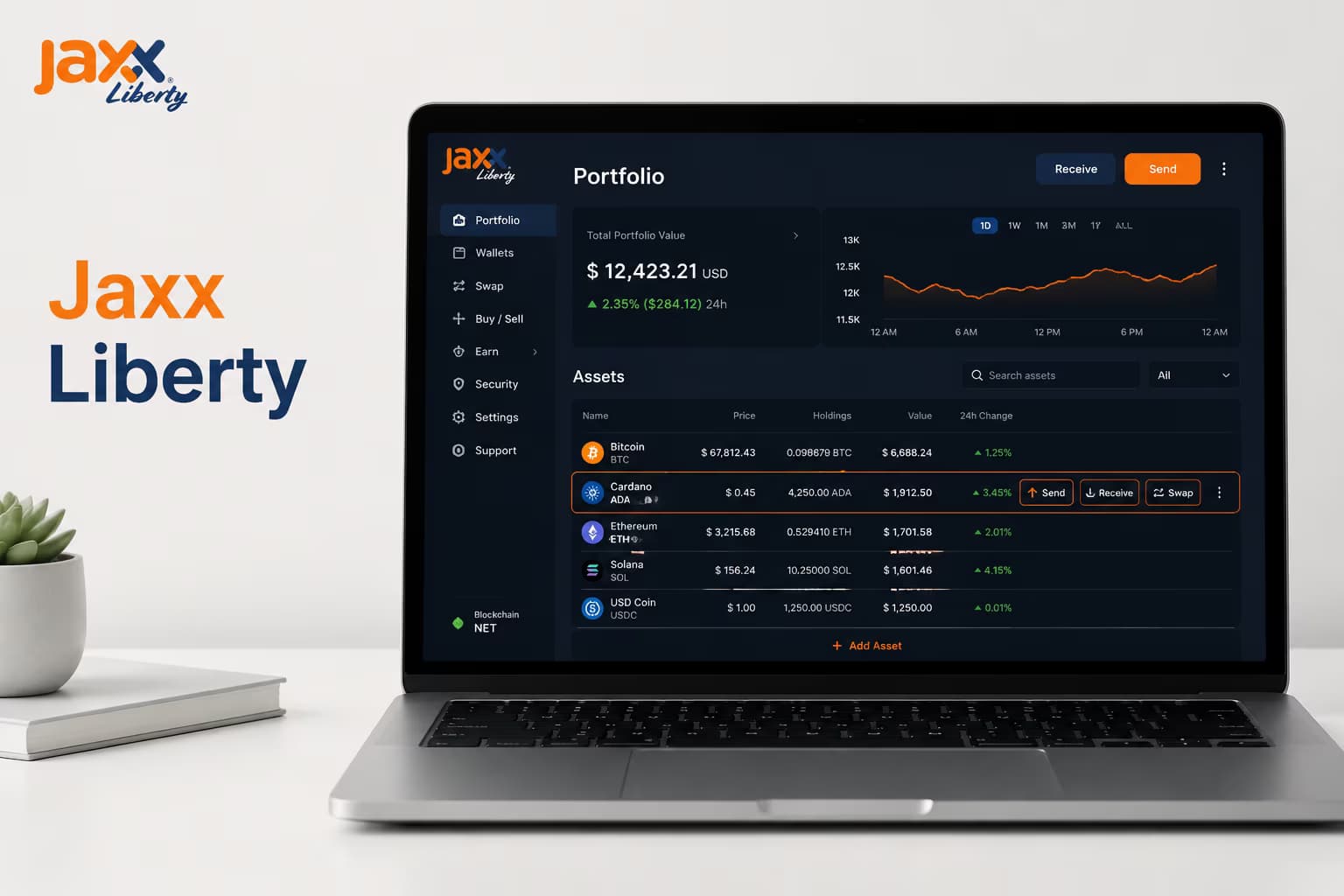
Send or receive Cardano in Jaxx Liberty and you are operating in pure self-custody — no third party holds your funds, controls your address, or can reverse a single transaction on your behalf. That is the hard line between a non-custodial wallet and an exchange account. On an exchange, the platform owns your private keys. It can freeze withdrawals, demand identity checks before letting funds move, or stall transfers inside a compliance queue that you have zero visibility into. Jaxx Liberty works the opposite way. Your private keys live locally on your device. Every transaction you initiate gets signed directly from your wallet — no intermediary, no permission slip required.
Your Cardano receive address is the first thing to get right before any transfer. It is generated deterministically from your seed phrase — unique to your wallet, consistent across every session, permanent. Before you hand that address to anyone or paste it into a third-party platform, verify it character by character. Not a glance. Every. Single. Character. Clipboard malware that silently swaps addresses mid-paste is one of the most ruthlessly effective attack vectors in self-custody. When ADA arrives, it appears in your wallet once the Cardano network confirms the transaction — usually within minutes, depending on network load. You do not need to «accept» anything. The address is always live.
Sending ADA demands the same discipline. You enter the recipient’s address manually or paste it, set the amount, and confirm. The wallet calculates the network fee automatically from current Cardano protocol parameters. The moment you confirm, that transaction is broadcast to the network and it does not come back. No support ticket reverses it. Jaxx Liberty has no mechanism to intervene after broadcast — and that is not a bug. Full control means full responsibility. That trade-off is completely intentional. As InnReg notes, self-hosted wallet transfers sit in a different regulatory category from custodial flows in the U.S. precisely because the user — not a financial institution — controls the keys and initiates every movement of funds.
Where self-custody really separates itself from exchange-controlled workflows is during high-traffic periods or regulatory events. Exchange users hit paused withdrawals, applied limits, surprise verification requirements. With Jaxx Liberty, your ability to send and receive ADA depends on exactly one thing: the Cardano network itself. Not a platform’s internal policies. Not a compliance queue. That makes self-custody far more predictable for anyone who needs consistent, uninterrupted access to their assets. The flip side is non-negotiable — your seed phrase requires the same intensity of protection a bank gives a vault. Lose it or expose it, and there is no recovery path. Nobody at Jaxx Liberty can restore access. That responsibility lands entirely on you, and it always will.
Cardano transfer costs and portfolio management considerations
Managing your ADA effectively requires understanding the difference between native network fees and the service charges applied by centralized platforms. When you use a self-custody solution like Jaxx Liberty, you benefit from the deterministic EUTXO model, which ensures transaction costs are predictable and not subject to the volatile fee markets seen on other networks. This transparency is essential for maintaining a multi asset crypto wallet 2026 strategy where every fraction of a token counts toward your long-term portfolio goals.
| Transfer Type | Estimated Cost (ADA) | Cost Logic & Predictability |
|---|---|---|
| Standard ADA Transfer | ~0.16 — 0.17 ADA | Fixed formula based on transaction size (bytes); highly predictable. |
| Complex DeFi/Smart Contract | Up to 0.80 ADA | Higher costs due to increased data size and script execution requirements. |
| Exchange Withdrawal | 0.50 — 2.00+ ADA | Includes platform service fees and minimum withdrawal thresholds. |
| Jaxx Liberty Self-Managed | Network Minimum | Direct interaction with the blockchain; no added intermediary markups. |
Manage your Cardano and other digital assets with full control. Connect your wallet to Jaxx Liberty to ensure your private keys remain local and your portfolio stays visible across all your devices.
Expert view on protecting Cardano wallet backups
Your 12-word recovery phrase is the only thing standing between you and permanent loss of funds — and Jaxx Liberty puts that responsibility squarely on your shoulders, where it belongs. Jaxx Liberty runs as a non-custodial wallet, meaning your private keys live on your device alone and never touch a remote server. No account system. No email fallback. No support team with a master key. Whatever ADA-related assets you manage through the wallet are protected by exactly one thing: that backup phrase. Lose it, and the funds are gone. Full stop.
Offline backup storage isn’t optional — it’s the foundation. Write your recovery phrase on paper. Put that paper somewhere physically brutal to reach: a fireproof safe, a locked drawer, a safety deposit box. Cloud services, note apps, screenshot folders — all of these are attack surfaces waiting to be exploited by malware, unauthorized access, or a platform breach you had nothing to do with. Make at least two physical copies and keep them in separate locations. One fire, one flood, one burglary shouldn’t be enough to wipe your access entirely. Analysts at Capital.com point out that ADA adoption keeps expanding, pulling first-time self-custody users into the market — and for those users, backup discipline isn’t a nice-to-have. It’s the entry fee.
Phishing is the other front. Attackers in 2026 are sophisticated: fake browser extensions, fraudulent app listings, support channels that look disturbingly legitimate — all engineered to get you typing your seed phrase into a malicious input field. Here’s the rule, and it has no exceptions: Jaxx Liberty will never ask for your recovery phrase through email, social media, or any support interaction. If anyone or anything asks for that phrase, you’re being attacked. Verify URLs before you touch them. Download Jaxx Liberty only from official sources. For a clear walkthrough of legitimate wallet recovery, the Jaxx Liberty seed phrase restore guide lays out the correct process step by step.
The rest of your security posture comes down to operational hygiene. Keep your device OS and the Jaxx Liberty app updated — outdated software is an open invitation. Use a strong device passcode. Never access your wallet on shared or public networks. And if your device feels compromised at all, don’t wait: grab a clean device, use your backup phrase, and move your assets to a fresh wallet address immediately. Jaxx Liberty’s architecture — local key storage, no centralized account, complete user control — means every security decision flows from how seriously you treat that backup. Your recovery phrase isn’t like a password. It is the asset. Treat it accordingly.
Main usability issues users face with Cardano in multi-asset wallets
Sync lag, ghost balances, buried asset listings, derivation mismatches — these are the four horsemen of Cardano visibility problems inside Jaxx Liberty, and every one of them has a fix. They’re not random. They follow predictable patterns rooted in how Cardano’s architecture diverges from Bitcoin or Ethereum-based chains — and once you understand the mechanics, troubleshooting stops feeling like guesswork.
Cardano’s extended UTXO model is the first thing to internalize. Unlike account-based chains that update a single balance pointer, Cardano tracks individual unspent outputs — and that requires its own node infrastructure to confirm what you actually hold. When the wallet hasn’t finished pulling the latest blockchain state, you get a zero or stale balance even when your ADA sits perfectly safe on-chain. Not a loss. A sync gap. In a multi-asset environment where Jaxx Liberty is simultaneously tracking Bitcoin, Ethereum, Litecoin, and a dozen other assets, Cardano’s sync process can fall behind — especially after the app has been idle or network conditions are poor. The fix is straightforward: stable connection, full sync, patience. Let the process finish before drawing any conclusions.
Visibility problems are a different beast entirely. When dozens of assets compete for screen space — particularly on mobile — Cardano can slip down the list and look absent when it isn’t. That’s a display priority issue, not a technical failure. Pin it. Move it up. Make it visible. Then there’s the derivation path problem, which cuts deeper. If your wallet was originally configured with a non-standard path, restoring the same seed phrase after a reinstall may surface a completely different Cardano address — one that looks empty because it is empty. Always verify that the derivation path used during initial setup matches what the wallet applies on restore. When standard troubleshooting hits a wall, Jaxx Liberty wallet support can walk you through your specific configuration directly.
Delayed balance updates deserve their own category. Even after a clean sync, Cardano takes longer to reflect recent transactions than faster-confirmation chains — that’s not a bug, that’s block time. Sent or received ADA recently? Give it several block confirmations before assuming something broke. Cross-reference your address on a public blockchain explorer: if the transaction shows there, it’s on-chain, and your wallet balance will catch up once sync closes the gap. One more thing — keep the Jaxx Liberty app current. Every update carries refined sync logic and the latest asset support configurations. Running an old version is an easy way to manufacture problems that don’t actually exist.
A practical checklist before sending or receiving ADA
Managing ADA requires precision to ensure your assets remain under your control. Before you initiate any transaction within Jaxx Liberty, follow this essential checklist to maintain security and accuracy.
- Verify the recipient address. Always double-check every character of the Cardano address. Malware can sometimes swap addresses in your clipboard, so visually confirm that the address in Jaxx Liberty matches the intended destination.
- Confirm the transaction amount. Ensure the amount of ADA you are sending is correct. Remember that once a transaction is broadcast to the blockchain, we cannot reverse it or recover the funds for you.
- Review network fees. Check the estimated transaction fee before hitting send. Cardano network fees are mandatory for processing transactions on the blockchain and are not collected by Jaxx Liberty.
- Check wallet sync status. Ensure your Jaxx Liberty Wallet is fully synced with the blockchain. An outdated sync status may show an incorrect balance or prevent your transaction from being broadcast properly.
- Validate your backup readiness. Confirm that you have your 12-word backup phrase written down and stored securely offline. Since Jaxx Liberty is a non-custodial wallet, your backup phrase is the only way to recover your ADA if your device is lost or damaged.
- Test with a small amount. If you are sending a large volume of ADA or using a new address for the first time, send a small «test» transaction first to ensure everything is working as expected before moving the full balance.
Why Cardano self-custody skills matter more in 2026
Self-custody wallet literacy in 2026 is a direct financial and legal obligation — not a nice-to-have skill for ADA holders who take their assets seriously. The 2025 Clarity Act classifies ADA as a commodity, which flips the tax reporting burden squarely onto your shoulders. The IRS now treats your self-custody wallet as the primary source of truth. Cost basis tracking, gain calculations, transaction documentation — all of it falls on you. No exchange generates those records for you. No custodial service saves you during an audit. If you hold ADA in a non-custodial wallet and can’t produce clean records when the IRS comes knocking, the penalties land on you. Full stop.
As experts at InnReg explain, U.S. regulatory guidance now draws a hard line between self-hosted wallets and custodial services. Self-hosted wallets are exempt from Travel Rule reporting requirements — but that exemption carries a price. Full accountability shifts to the individual user. You own the keys. You own the records. You own the consequences. This is precisely the architecture Jaxx Liberty runs on: private keys stored locally on your device, no centralized account system, no email-based recovery. Your seed phrase is the only path in. That means wallet security and backup discipline aren’t suggestions — they are the literal foundation of your financial safety under the current regulatory framework.
The market context sharpens the urgency. Bloomberg analysts put ETF approval odds for ADA at 75%, and growing institutional interest keeps pulling retail holders deeper into the ecosystem. More participants means more attack surface — more phishing campaigns, more wallet exploits, more social engineering. A multi asset crypto wallet in 2026 needs to do more than hold tokens. It needs to support your ability to manage assets across multiple networks while keeping your keys completely under your control. That is exactly what Jaxx Liberty is built for: cross-platform access, multi-asset support, and a non-custodial architecture that never hands custody to a third party.
A serious cardano wallet overview in 2026 has to reckon with three converging pressures at once: regulatory compliance, cardano wallet safety, and the real-world complexity of managing a portfolio that keeps growing. Understanding your cardano storage options — and picking one that gives you full key ownership — is the difference between being prepared and being exposed. Jaxx Liberty puts control in your hands. But control and responsibility are the same thing here. Know your seed phrase. Keep your transaction records clean. Treat your wallet for what it legally is: a financial instrument with real consequences attached.
Conclusion
Managing ADA inside Jaxx Liberty runs on three non-negotiable habits: confirm asset support, keep your Cardano balance front and center in your portfolio, and scrutinize every transfer before you hit send. These principles hold whether you’re moving ADA for the first time or running a multi-asset strategy across a dozen different tokens. Get them right early. The cost of getting them wrong is entirely yours to bear.
Cardano wallet usability lives or dies by how thoroughly you set things up before you actually need them. Make sure ADA shows up correctly in your asset list — not «probably there,» but confirmed. Use the exact wallet address Jaxx Liberty generates for each transaction, and never trust your memory with an address string. Copy it. Paste it. Read it back. One wrong character and that transfer is gone for good — Jaxx Liberty holds your private keys locally on your device, and no one else has access to them. That’s the whole point. That’s also the whole risk.
Your seed phrase is the only lifeline your Cardano holdings have. Lose it, and there is no support ticket, no recovery process, no fallback. Write it on paper. Store that paper somewhere physically secure — not a cloud folder, not a screenshot, not a chat message to yourself. Self-custody wallets are built on a simple, unforgiving principle: full control means full responsibility. Jaxx Liberty hands you that control completely.
Think of your Jaxx Liberty wallet as a precision instrument. Check which assets are supported before you initiate any transfer. Keep your portfolio view clean so balances stay visible at a glance. Guard your recovery phrase the way you’d guard a physical key to a vault. None of this is optional. These habits aren’t best practices — they’re the baseline for anyone serious about managing crypto on their own terms.
Frequently Asked Questions
How does Jaxx Liberty display my Cardano (ADA) balance?
Jaxx Liberty fetches your ADA balance by querying external Cardano nodes and block explorers via API calls, pulling your UTXO set, transaction history, and native token metadata simultaneously. The portfolio refreshes on app launch, on manual sync, and through background polling every 30 to 60 seconds.
How do I make Cardano visible in my Jaxx Liberty wallet?
Open the hamburger menu in the top right corner, select ‘Manage Assets,’ search for Cardano (ADA), and toggle the switch to the ‘On’ position. Return to your dashboard to confirm the ADA card is now visible with your current balance.
What are the transaction fees for sending ADA through Jaxx Liberty?
Cardano uses a fixed mathematical formula for fees, so a standard ADA transfer costs approximately 0.16 to 0.17 ADA. Jaxx Liberty applies no intermediary markup — you pay only the core blockchain validation cost, which is significantly lower than typical centralized exchange withdrawal fees.
How should I store my Jaxx Liberty 12-word recovery phrase for Cardano?
Write your recovery phrase on paper and store it in at least two separate, physically secure locations such as a fireproof safe or safety deposit box. Never save it digitally in cloud services, note apps, or screenshots, as these are vulnerable to malware and unauthorized access.
Why is my Cardano balance showing incorrectly or not updating in Jaxx Liberty?
Stale or zero balances are typically caused by sync lag — Cardano’s eUTXO model requires its own node infrastructure to confirm holdings, and the wallet may fall behind after idle periods or poor network conditions. Ensure a stable internet connection, trigger a manual refresh, and allow the sync to complete fully before drawing conclusions.